Training and performance support are two different jobs

One builds the judgment your team carries into a task. The other delivers the right answer while they’re standing in front of it. Frontline teams need both — and most tool stacks only do one.

Train before the task

Support during the task

Both in one mobile app

What each one is actually for

On a feature list they look interchangeable. In practice they are used at different moments, by people in very different states of mind, and they fail in completely different ways.

Ahead-of-time training

Used before the work. The learner has attention to spare.

Training is how a person builds a mental model — why the procedure exists, what good looks like, and what to do when the situation doesn’t match the checklist. It takes time on purpose. You cannot compress judgment into a search result.

  • Onboarding and role readiness

  • Safety, compliance, and certification

  • Judgment for situations no document covers

  • Standards, culture, and the reasoning behind the rule

Ahead-of-time training

Used before the work. The learner has attention to spare.

Training is how a person builds a mental model — why the procedure exists, what good looks like, and what to do when the situation doesn’t match the checklist. It takes time on purpose. You cannot compress judgment into a search result.

  • Onboarding and role readiness

  • Safety, compliance, and certification

  • Judgment for situations no document covers

  • Standards, culture, and the reasoning behind the rule

Just-in-time performance support

Used during the work. The learner has seconds, one free hand, and a problem.

Performance support is how a person gets the one right answer without leaving the task. Success is measured in seconds to answer, not minutes of seat time. Anything that reads like a course is a failure here.

  • Step-by-step task guides with photos

  • Specs, settings, tolerances, and part numbers

  • Troubleshooting one specific fault

  • The procedure as it changed this morning

Just-in-time performance support

Used during the work. The learner has seconds, one free hand, and a problem.

Performance support is how a person gets the one right answer without leaving the task. Success is measured in seconds to answer, not minutes of seat time. Anything that reads like a course is a failure here.

  • Step-by-step task guides with photos

  • Specs, settings, tolerances, and part numbers

  • Troubleshooting one specific fault

  • The procedure as it changed this morning

Most teams buy one of these, then spend years wondering why the other problem never goes away.

Most teams buy one of these, then spend years wondering why the other problem never goes away.

The cost of picking one

What breaks when you only have half

What breaks when you only have half

Nearly every organization we talk to has already over-invested in one side.
The symptoms are predictable enough that you can usually name the gap before we open the platform.

Nearly every organization we talk to has already over-invested in one side. The symptoms are predictable enough that you can usually name the gap before we open the platform.

Training with no support

Your people finish the course, walk onto the floor, and improvise. What survives is whatever they remember under pressure, and that decays fast. You see rework, inconsistent quality, and the same three questions escalating to the same two experts.

Support with no training

Your team can look up any step, but nobody knows which step to take. Documents answer how and never why, so the moment reality diverges from the document, work stops — or somebody guesses and keeps moving.

Two systems, two logins

An LMS for courses, a shared drive or wiki for reference. The two libraries drift apart, updates land in one and not the other, and frontline workers quietly abandon whichever one is harder to reach.

Nothing built for the phone

Deskless workers don’t have a browser tab open. If either mode needs a laptop, a VPN, or a steady signal, it does not exist for the people actually doing the work.

Side by side

Same library. Different moment of need.

The distinction that matters is not the subject matter. It is when someone reaches for it, and what they need back in that particular second.

Nearly every organization we talk to has already over-invested in one side. The symptoms are predictable enough that you can usually name the gap before we open the platform.

Where they differ

Ahead-of-time training

Just-in-time performance support

Moment of need

Moment of need

Ahead-of-time

A new skill, a new role, a new policy

Just-in-time

A task in progress, a problem in front of them

Success measure

Success measure

Ahead-of-time

Can they perform it unaided later?

Just-in-time

Seconds to the right answer

Attention available

Attention available

Ahead-of-time

Scheduled and protected

Just-in-time

Interrupted, hands busy, often noisy

Content shape

Content shape

Ahead-of-time

Sequenced, with context and practice

Just-in-time

Atomic, searchable, one answer

Typical length

Typical length

Ahead-of-time

Minutes to hours

Just-in-time

Seconds

What failure looks like

What failure looks like

Ahead-of-time

Knowledge decays before it is ever used

Just-in-time

They ask a coworker, or they guess

In practice

One task, both modes

Here is what a blended approach looks like around a single procedure — say, a lockout step that just changed on one piece of equipment.

Nearly every organization we talk to has already over-invested in one side. The symptoms are predictable enough that you can usually name the gap before we open the platform.

01

Before the shift

A five-minute card explains why the step changed and what goes wrong without it. People practice the decision, not just the sequence, so the reasoning travels with them.

01

Before the shift

A five-minute card explains why the step changed and what goes wrong without it. People practice the decision, not just the sequence, so the reasoning travels with them.

01

Before the shift

A five-minute card explains why the step changed and what goes wrong without it. People practice the decision, not just the sequence, so the reasoning travels with them.

02

On the floor

The same procedure is one tap away as a photo-led guide. No login wall, no scrolling a forty-page PDF, no waiting for a signal that isn’t there.

02

On the floor

The same procedure is one tap away as a photo-led guide. No login wall, no scrolling a forty-page PDF, no waiting for a signal that isn’t there.

02

AI Builds Your Groups & Topics

The same procedure is one tap away as a photo-led guide. No login wall, no scrolling a forty-page PDF, no waiting for a signal that isn’t there.

03

When it changes again

You update the topic once. Everyone’s reference and everyone’s training reflect it on the next open — not at the next annual recertification.

03

When it changes again

You update the topic once. Everyone’s reference and everyone’s training reflect it on the next open — not at the next annual recertification.

03

When it changes again

You update the topic once. Everyone’s reference and everyone’s training reflect it on the next open — not at the next annual recertification.

04

When you need proof

xAPI data shows who completed the training and who is still pulling the guide in the field. Heavy lookup traffic on one step tells you exactly where training didn’t stick.

04

When you need proof

xAPI data shows who completed the training and who is still pulling the guide in the field. Heavy lookup traffic on one step tells you exactly where training didn’t stick.

Why SparkLearn

One platform, both jobs, one app

SparkLearn was built for frontline and deskless teams, where the gap between learning something and doing it is measured in steps, not screens. The same content library serves both moments: sequenced when someone is building the skill, atomic and searchable when they are mid-task.

Because it is one system, your instructional designers author once, your admins update once, and your people only ever open one app.

What you get in one place:

  • Microlearning cards for ahead-of-time training, with spaced reinforcement so it survives past the quiz

  • Searchable task guides, specs, and troubleshooting built for one-handed lookup in the field

  • Mobile-first and offline-capable, for people who have never had a desk

  • One authoring workflow — publish a topic once and it serves both moments

  • xAPI and LRS reporting that spans training completion and real field usage

  • Integrations with the systems your content already lives in, so nothing gets re-keyed
A gradient of oranges, pinks, purples, and yellows blending together to create a dreamy atmosphere.

Your Teams Deserve the Best Learning Experience

SparkLearn will be there to support you from content creation to analyzing user xAPI data. Reach out today to find out what SparkLearn can do to improve your teams' training.

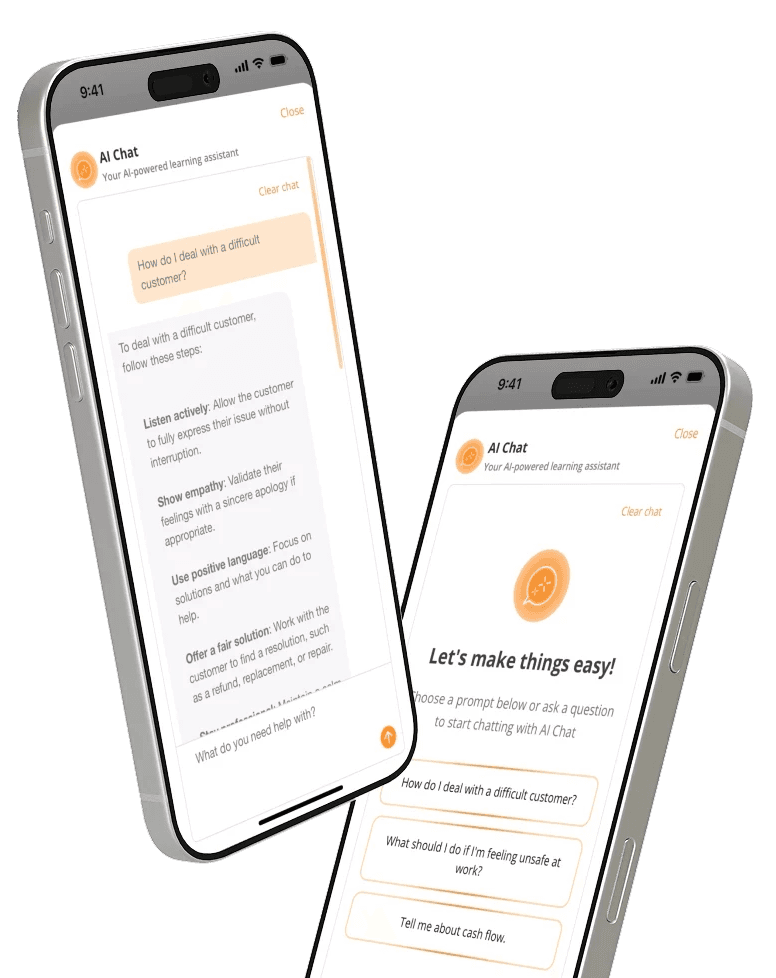
Two iPhones floating at an angle. On the screens they show a conversation with SparkLearn's AI Chat.
Bg

Your Teams Deserve the Best Learning Experience

SparkLearn will be there to support you from content creation to analyzing user xAPI data. Reach out today to find out what SparkLearn can do to improve your teams' training.

A gradient of oranges, pinks, purples, and yellows blending together to create a dreamy atmosphere.

Your Teams Deserve the Best Learning Experience

SparkLearn will be there to support you from content creation to analyzing user xAPI data. Reach out today to find out what SparkLearn can do to improve your teams' training.

Two iPhones floating at an angle. On the screens they show a conversation with SparkLearn's AI Chat.